Serving 3 million Subscribers
Web3 Gateways Programme

Gateways To Web 3


Rationale
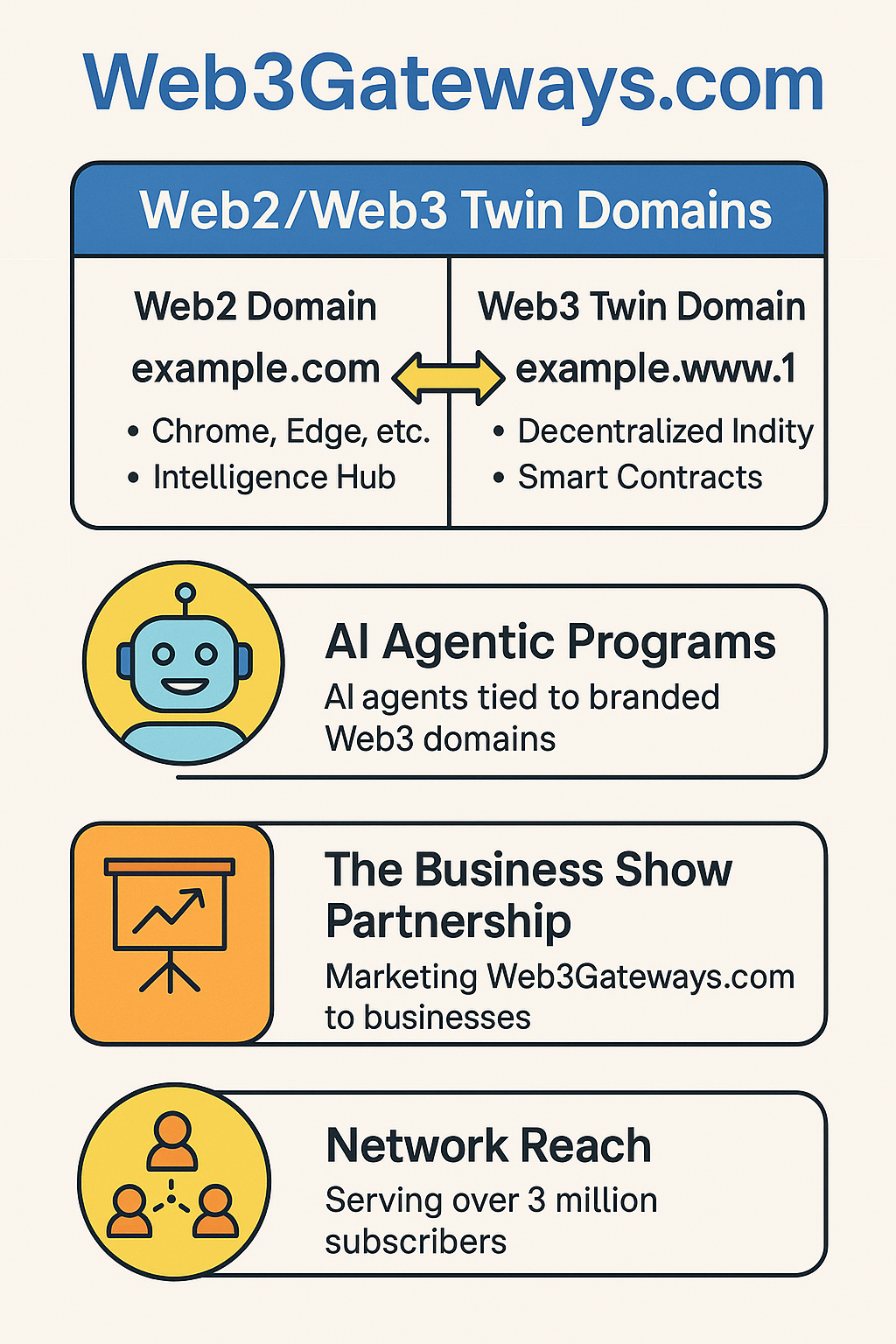
"Prime domain names double as branded marketing endpoints and as deployment namespaces for specific verticals. Serving over 3 million subscribers across a Network of sites"Web3Gateways.com is an IBM Partner Programme launching in 2026.
It will provide a next-generation dual-stack Web2/Web3 domain infrastructure enabling any business to:
Agentic AI consists of AI agents, (e coordinated through AI orchestration), that mimic human decision-making, to solve problems in real time. In a multiagent system, each AI Agent performs specific tasks, to reach specific goals, as part of a team.
Unrepeatable Opportunity
This is an unrepeatable opportunity of the kind last presented in the mid 1990's, when the Internet entered the mainstream, and people were able to acquire generic prime web 2 domains for specific industries. People were able to acquire generic prime web 2 domains for specific industries. Many of those domains are now worth many millions of US Dollars.The Web-3 Agentic AI Auction will provide an opportunity in 2025, for people were able to acquire generic prime web 3 domains for specific industries. Those domains have extra dimensions, additional to the branding they provide, as they can also act as AI agents in Agentic Programmes.
About Agentic AI
At its core, agentic artificial intelligence (AI) refers to the use of AI – normally of the “generative AI” persuasion – to create and execute automation improvements using autonomous, self-directing AI code. Rather than simply responding to prompts with human-sounding answers, it gathers information; uses that information to make decisions; then executes activities based on those decisions.The difference between agentic AI and traditional computing is that the AI agent is autonomous. Traditional computer programs are limited to the options pre-coded by their programmers, while AI agents can execute actions that the programmers might never have imagined. Key characteristics of Agentic AI include: